

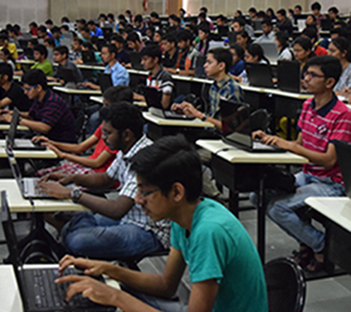
 DAU's B.Tech. in Computer Science and Artificial Intelligence (CSAI) is a four-year undergraduate program designed for students who want strong foundations in Computer Science together with modern Artificial Intelligence. Computing systems now drive innovation across technological sectors, and AI increasingly enables pattern discovery, prediction, and decision-making across domains such as vision, speech, natural language processing, robotics, healthcare, business, and finance.
The CSAI program combines the theory, design, and application of computing systems with the concepts, tools, and technologies needed to create intelligent systems. The curriculum is designed to prepare students for both research and industry by building mathematical maturity, systems understanding, and AI-oriented problem-solving capability.
The B.Tech. CSAI program follows the Common Curriculum Framework (CCF) for B.Tech. programs at DAU. The curriculum combines a shared institute-level foundation with program-specific depth in Computer Science and Artificial Intelligence. Under the CCF, students complete Institute Core courses, Program Core courses, Program Electives, and Free Electives, together with co-curricular activities, internships, certificate courses, and a final B.Tech. Project / Internship.
The program is structured to build foundations first and specialization later. The early semesters emphasize programming, mathematics, data structures, digital systems, communication skills, and design orientation. The second year develops algorithmic and systems foundations together with introductory machine learning. The later semesters expand into deeper AI and advanced computing areas through core courses, electives, projects, internships, and the B.Tech. Project / Internship.
Course Categories
- Institute Core (IC): Mandatory courses common to all B.Tech. students under the Common Curriculum Framework.
- Program Core (PC): Mandatory courses specific to the CSAI program.
- Program Electives (PE): Elective courses in the primary areas of the CSAI program.
- Free Electives (FE): Courses outside the primary area of the program; at least one Free Elective should be from HSSE.
Broad Curriculum Components
- Foundation and Core Courses:
Students build strength in programming, algorithms, data structures, systems, databases, mathematics, machine learning, and AI foundations. - Elective Courses:
From the middle semesters onward, students broaden or deepen their exposure through structured elective baskets. - Internships and Project Work:
The curriculum includes a Rural Internship, a Summer Research / Industry Internship, project-based elective options in later semesters, and a final-semester B.Tech. Project / Internship. - Co-curricular, Design, and Certificate Components:
The common framework includes co-curricular activities, design/exploration components, and two online certificate courses.
Common Curriculum Framework Summary
| Component | Requirement | Remarks |
|---|---|---|
| Institute Core (IC) | 17 courses | Semesters I through V; common B.Tech. foundation, excluding internships and other non-course components. |
| Program Core (PC) | 12 courses | Semesters I through VI; program-specific core depth. |
| Program Electives (PE) | 8 courses | Semesters IV through VII; elective courses in areas of primary interest of the program. |
| Free Electives (FE) | 2 courses | Semesters VI and VII; at least one Free Elective should be from HSSE. |
| Certificate Courses | 2 courses | Online certificate courses; Pass/Fail basis. |
| Internships and BTP/ITP | Rural Internship, Summer Internship, BTP/ITP | Experiential components including final B.Tech. Project / Internship. |
| Optional Honors Tracks | Minor / Research | Students may pursue optional Honors Minor or Honors Research tracks subject to eligibility and approved requirements. |
CSAI Program Core Progression
The CSAI Program Core is designed to move from foundations to advanced AI and systems topics. The proposed CSAI Program Core sequence is as follows.
| Course Code | CCF Slot | CSAI Course Title | Semester |
|---|---|---|---|
| PC-101 | Program Core 1 | Mathematical, Algorithmic and Computational Thinking | Semester I |
| PC-102 | Program Core 2 | Discrete Mathematics | Semester II |
| PC-203 | Program Core 3 | Algorithms | Semester III |
| PC-204 | Program Core 4 | Operating Systems | Semester III |
| PC-205 | Program Core 5 | Optimization | Semester III |
| PC-206 | Program Core 6 | Database Management Systems | Semester IV |
| PC-207 | Program Core 7 | Foundations of AI | Semester IV |
| PC-208 | Program Core 8 | Software Design and Development | Semester IV |
| PC-309 | Program Core 9 | Deep Learning | Semester V |
| PC-310 | Program Core 10 | Big Data Processing | Semester V |
| PC-311 | Program Core 11 | Trustworthy AI | Semester V |
| PC-312 | Program Core 12 | Reinforcement Learning | Semester VI |
Semester-wise Academic Structure
| Semester | Courses / Components | Credit Note |
|---|---|---|
| I | HSS I (Language and Literature); Introduction to Programming; Programming Lab; Basic Electronic Circuits; Maths I (Calculus); Mathematical, Algorithmic and Computational Thinking; Co-curricular - 1 | 19-20 course credits |
| II | HSS II (Approaches to Indian Society); Data Structures; Digital Logic / Computer Organization; Maths II (Linear Algebra); Language in Practice; Discrete Mathematics; Design Thinking for Engineers; Co-curricular - 2 | 21 course credits |
| III | HSS III (Science, Technology and Society); Object-Oriented Programming; Maths III (Probability and Statistics); Algorithms; Operating Systems; Optimization; Co-curricular - 3; Exploration Project | 21 course credits |
| IV | Environmental Studies; Introduction to Machine Learning; Database Management Systems; Foundations of AI; Software Design and Development; Program Elective - 1; Co-curricular - 4 | 22-23 course credits |
| V | Principles of Economics; Deep Learning; Big Data Processing; Trustworthy AI; Program Elective - 2 | 18-19 course credits |
| VI | Reinforcement Learning; Program Elective - 3; Program Elective - 4 / Project - 1; HSSE / Free Elective; Program Elective - 5 | 14-16 course credits, depending on elective/project choices and load flexibility |
| VII | Program Elective - 5/9; Program Elective - 6 / Project - 2; Program Elective - 7 / Project - 3; Program Elective - 8; HSSE / Free Elective | 17-20 course credits, depending on elective/project choices and load flexibility |
| VIII | B.Tech. Project / Internship Training Project (BTP/ITP) | Final project / internship component |
Electives and Advanced Pathways
The elective design allows students to build depth in AI while retaining exposure to rigorous Computer Science and adjacent technical areas. Subject to prerequisites and semester-wise availability, students are expected to complete:
- a minimum of three elective courses from AI and its Applications;
- a minimum of two elective courses from Computer Science and Engineering; and
- the remaining electives from the approved elective baskets.
| Indicative Elective Basket | Indicative Courses |
|---|---|
| AI and its Applications | Information Retrieval; Natural Language Processing; Generative AI; Large Language Models; MLOps; LLMOps; AI in Healthcare; Computer Vision; Digital Image Processing; Speech Processing; Recommendation Systems; Adversarial ML; Quantum ML; Robotics; Control of Autonomous Systems. |
| Computer Science and Engineering | Theory of Computation; Computer Networks; Advanced Data Structures; Algorithmic Graph Theory; Compiler Design; Formal Specification and Verification; Randomized Algorithms; Approximation Algorithms; Parallel Algorithms; Cryptography; Human-Computer Interaction. |
| Computational Science | High Performance Computing; Distributed Computing; Cloud Computing; GPU Computing; Quantum Computing; Modeling and Simulation. |
| Mathematics | Numerical and Computational Methods; Game Theory; Combinatorial Optimization; Operations Research; Algebraic Structures. |
| Data Science and Engineering | Signals and Systems; Data Analysis and Visualization; Data Security and Privacy; Advanced Database Management Systems; Bayesian Data Analysis; Time Series Analysis; Business Data Analysis; Financial Data Analysis. |
Optional Honors Tracks
In line with the Common Curriculum Framework, students may additionally pursue optional Honors Minor or Honors Research tracks, subject to approved eligibility, progression requirements, and availability.
- Honors Minor Track: Designed for students who wish to specialize in a specific domain through additional coursework and/or project components.
- Honors Research Track: Designed for students who wish to pursue higher studies or research careers through honors courses and supervised thesis components.
Programme Outcomes (POs)
After successful completion of the B.Tech. in Computer Science and Artificial Intelligence (CSAI) program, students will be able to:
| PO No. | Programme Outcome | Description |
|---|---|---|
| PO1 | Engineering and Computing Knowledge | Apply knowledge of mathematics, statistics, science, computing fundamentals, and artificial intelligence to solve complex engineering and computational problems. |
| PO2 | Problem Analysis | Identify, formulate, review relevant literature, and analyze complex computing and AI problems using principles of mathematics, data analysis, and computer science to reach substantiated conclusions. |
| PO3 | Design and Development of Solutions | Design and develop software systems, intelligent models, and data-driven solutions that meet specified needs with due consideration for usability, safety, societal context, and sustainability. |
| PO4 | Investigation of Complex Problems | Conduct investigations using research methods, experimentation, model evaluation, data interpretation, and evidence-based reasoning to derive valid conclusions for computing and AI systems. |
| PO5 | Modern Tool Usage | Select and apply appropriate techniques, platforms, programming frameworks, AI/ML libraries, data tools, and engineering practices to build and evaluate complex systems, while understanding their limitations. |
| PO6 | The Engineer and Society | Apply contextual knowledge to assess societal, legal, cultural, accessibility, and human-centered considerations relevant to professional computing and AI practice. |
| PO7 | Environment and Sustainability | Understand the environmental and societal impact of computing infrastructure and AI solutions, and make informed choices that support sustainable technological development. |
| PO8 | Ethics | Apply ethical principles and commit to professional responsibilities in the design, deployment, and use of software and AI systems, including issues of bias, privacy, fairness, transparency, and safety. |
| PO9 | Individual and Team Work | Function effectively as an individual and as a member or leader in diverse, multidisciplinary, and collaborative teams. |
| PO10 | Communication | Communicate effectively with technical and non-technical audiences through reports, design documents, visual presentations, and clear oral and written interaction. |
| PO11 | Project Management and Finance | Apply engineering and management principles to plan, execute, and manage projects in computing and AI, including teamwork, scheduling, resource use, and economic considerations. |
| PO12 | Life-long Learning | Recognize the need for independent and life-long learning in response to rapid advances in computer science, artificial intelligence, and related interdisciplinary domains. |
Programme Specific Outcomes (PSOs)
The B.Tech. in Computer Science and Artificial Intelligence (CSAI) program is designed to enable students to:
| PSO No. | Programme Specific Outcome | Description |
|---|---|---|
| PSO1 | Core Intelligent Systems Design | Apply foundations in algorithms, data structures, databases, operating systems, mathematics, probability, statistics, and optimization to analyze, design, and implement intelligent computing systems. |
| PSO2 | AI Model Development and Deployment | Build, evaluate, and deploy machine learning, deep learning, reinforcement learning, and data-intensive solutions using modern software engineering, big data, and computational tools. |
| PSO3 | Responsible and Applied AI Practice | Develop AI-enabled solutions for real-world and interdisciplinary applications with due attention to fairness, privacy, explainability, robustness, safety, and societal impact. |